Posts

Showing posts with the label supernova hunting

Supernova #29

Image
  At 1:30 AM on the morning April 28, it was time to pick a new set of target galaxies during my nightly search for supernovae. My sidereal clock displayed 15:31, so I chose to get a headstart on 16h galaxies. Late April is still considered Galaxy Season, but when 16h is approaching the meridian, the densest part of the Realm of the Galaxies is three hours over to the west and fading fast.  Looking due south at 16 o'clock sidereal time, you'll see the early summertime constellations (Scorpius, Ophiuchus, and Hercules) just east of the meridian, and the tail end of the springtime constellations (Libra, Corona Borealis, and Boötes) on the west side. Seasoned backyard astronomers know that 16h is where we transition from observing galaxies to seeking out globular star clusters that have been hiding from us for months. But while globular clusters are great targets to view in the eyepiece of backyard telescopes, they are not the apple of the eye of supernova hunters! For me, when t...

2025 in review

Image
  Let me just say right up front that 2025 was a very difficult year for me, personally. It may have been even worse than the year of the COVID-19 pandemic. But I won't go into the details of why 2025 was so horrible for me. This blog is not about my personal life. It's about my life as a backyard astronomer. And ironically, even though 2025 was lousy in many respects personally, it turned out to be my best year of astronomical imaging. In my first blog of 2025, I gave a report of my imaging performance in 2024 . It was pretty good. At least I got as many imaging nights (282) in 2024 as I got in the previous year. And I found 5 supernovae in 2024, which was an improvement upon the 4 that I came across in 2023. But 2024 was my fourth year in a row in which I wasn't able to achieve 300 nights of imaging. It seemed that my current location in Tucson was not as good for astronomy as my old house on the west side. After all, in each of the years from 2017 to 2020 at my former re...

Supernova in the Deer Lick Galaxy

Image
A couple of nights ago, I found a supernova in galaxy NGC 7331, also known as the "Deer Lick Galaxy." It was the final image I took on the night of August 8, 2025. But I didn't notice the supernova. I didn't see any new stars in the vicinity of the galaxy, and I proceeded to shut down my telescope and camera for the night. But as I downloaded the night's worth of images from my imaging laptop (that's attached to my telescope tripod with double-stick tape), I decided to adjust the contrast and brightness of my image of NGC 7331 and see if a supernova might be lurking in the bright nucleus of the galaxy. To my great surprise, there was, indeed, a supernova in hiding! In the old days, when we astrophotographers used emulsion films to take pictures of celestial objects, we routinely overexposed the cores of galaxies in order to reveal their fainter spiral arms. We considered the washout of the galactic core to be an acceptable loss in order to gain views of faint...

Supernova #25

Image
  The sky was clear, but a bright full moon was rising low in the southeastern sky. My solution was to shoot galaxies in the northwestern sky, far away from the moon. Although my sidereal clock showed 14:33 at the start of my session, I chose my list of targets at 13 hours of Right Ascension, an hour-and-a-half west of the meridian.  I like the 13-hour list of galaxies. It includes the impressive Whirlpool Galaxy, M 51, the curious Sunflower Galaxy, M 63, and at the southern end of the list (for me, in the northern hemisphere), there is the beautiful face-on spiral galaxy, M 83, in Hydra. I never tire of these targets. They are standouts amongst the many smaller and uninteresting elliptical galaxies on my lists.  Last night, I moved on from M 63 and shot NGC 5005, which is a smaller version of M 63. Nothing new there, so I sent the scope onto my next target, NGC 5033. Although the bright center of NGC 5033 appears smaller than NGC 5005, its faint but sprawling spiral arms...

My 24th supernova "discovery"

Image
  Tonight, I witnessed a supernova explosion in galaxy NGC 5957. As usual, I was not the first to see it. As a matter of fact, I last photographed NGC 5957 on March 25th, and there was no supernova in it. But the very next night, the supernova was discovered! I shot it one day too soon! At least in this case, a fellow amateur astronomer, Koichi Itagaki, got credit for the discovery. He picked it up and reported it before all the big professional surveys got their grubby paws on it, which is pretty impressive! The designation "fvw" translates to the 4,651st supernova discovery of 2025.  Supernovae can be seen for up to a year after their eruptions, so supernova hunters like me can gradually get around to finding them long after the official discovery. But as far as I'm concerned, I "discovered" this supernova, too! I do my best to avoid the spoiler alerts and, if their host galaxies happen to be on my target lists, I will come across them sooner or later, as I di...

Spinoffs from supernova hunting

Image
Even I have to admit it: supernova hunting is boring. I take pictures of 10,000 galaxies per year, on average, and I'll find only 5 supernovae in that time period. Another way to look at it is that I shoot galaxies on 250+ nights per year. Thus, you could either say that I look at 9,995 galaxies per year and don't find a supernova in any of them, or you could say that I search for supernovae on 245 nights per year and don't make a discovery. That's a lot of time spent, and a lot of galaxies imaged with no discoveries made! Now you take ol' M 95 here, for instance. I've shot this galaxy on 73 nights over the past 10 years, and I've never discovered a supernova in it. In 2012, I heard about a supernova in M 95, and I took some pictures of it. But that wasn't a "discovery" for me. And I haven't seen a supernova in it since then. So, you could also say that I've been looking at this galaxy for 13 years without finding a supernova in it. Yea...

Discovering an asteroid and a supernova with a single shot

Image
Imagine if you wanted to begin searching for supernovae by just shooting random galaxies every night and looking for new stars in your images. How many nights do you think it would take before you'd find a supernova? Or what if you wanted to search for asteroids by shooting galaxies that are in zodiac constellations and waiting to find an asteroid passing nearby to a galaxy? How long would that take to find your first asteroid? Of course, you could get lucky and find either a supernova or an asteroid on your first night of trying. But I was not that lucky! It took me nearly two years to find my first supernova (which had already been discovered several months before I found it). It took longer than two years before I was "fooled" for the first time by an asteroid close to one of my target galaxies. Not long after midnight on January 27th, after 10 years of searching for supernovae, I finally "discovered" an asteroid and a supernova in the same field of view! Wh...

How long does a supernova last?

Image
  The other night, I thought I discovered a supernova in NGC 3621. When I checked online for supernova discoveries, there were none reported for galaxy NGC 3621. Weird. I've always assumed that any supernova that I come across will have already been discovered by the pro's. Wow! Maybe my discovery is legit! Or maybe, I thought, all of the pro teams hadn't yet reported their discoveries. But the following morning, when there were still no reports of supernova discoveries in NGC 3621, I began to have doubts. I continued to check in all day long and there were still no reports for NGC 3621. Weirder.  I haven't yet figured out how to report a possible supernova, but I sent an email to David Bishop of the Rochester Astronomy website. He said there weren't any reports of a supernova in NGC 3621, but that there was a supernova in that galaxy last year: 2024ggi. Hmmm. That jogged my memory. Back in April of 2024, supernova 2024ggi was so bright that it caught the attention ...

2024 in review

Image
  There's nothing more blatantly honest than a graphical representation of data. You may ask, "How did 2024 treat you?" And I may answer, "Pretty good." But how do we quantify what we're talking about? Well, in the first place, if we're quantifying the "goodness of 2024," we need to decide on a subject area. For instance, we could ask about our health, our finances, or our love life in 2024. And in the second place, we need to compare 2024 to previous years, to get a feel for whether 2024 was better or worse than all the others that came before it. Thirdly, we need some way to measure the joy.  Since my blog is about backyard astronomy, it is appropriate for me to ask, on this first day of 2025, "How was 2024, in terms of stargazing opportunities?" Amateur astronomers are not always the best note takers! Some of us may keep meticulous records of our observations, while others of us can't be bothered with the chore of writing thing...

A comet hunter, too?

Image
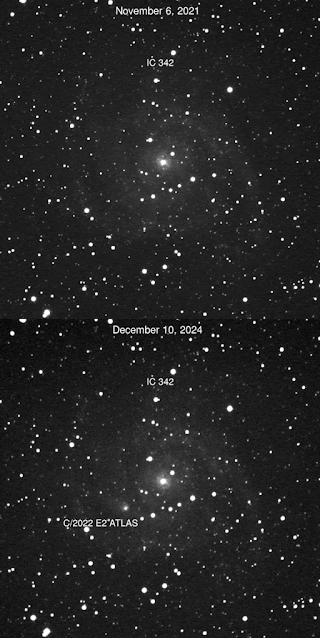
  Last night, while imaging my target galaxies at 3 hours R.A., there was a "new star" in galaxy IC 342. The star looked a little funny, though. It was large and fuzzy, unlike the appearance of a supernova or asteroid. Did I just discover a comet? Yes, and no. Cartes du Ciel, the planetarium software I use, identified the interloper as Comet C/2022 E2 ATLAS. The date within the name indicates that this comet was discovered two years ago. You might wonder why I am just now getting around to seeing it. Well, comets are movers. No, they don't go zipping across the sky like meteors. They move more slowly, like the planets and asteroids do. If you follow them for an hour, or so, you'll detect their motion against the background stars. If you catch them inbound but way out beyond Jupiter's orbit, you can continue following them for months. And when a comet reaches the inner solar system, the heat of the sun will cause its surface to melt a little and allow gas and dust...

The life of a supernova hunter

Image
  Supernova in galaxy NGC 2146 I found a supernova in NGC 2146 last night. No, I was not "the discoverer" of the supernova. That would be the Japanese astronomer Koichi Itagaki. He discovered it 5 days earlier. But I didn't know it. I came across it on my own during my nightly search for supernovae in the distant galaxies. Supernova hunting has been my hobby since 2016, and supernova 2024abfl is the 21st supernova I've come across. You can look up supernovae on Wikipedia, so I won't waste your time by describing them here. What I would like to talk about, however, is the sport of supernova hunting.  Supernova hunting falls under the umbrella of backyard astronomy. If you were to purchase a telescope to get a closer look at the stars and planets, there are a number of astronomical activities you might eventually become interested in. Like most people, you'll probably be disappointed in the dull-gray eyepiece views of nebulae and galaxies, after seeing brilliant...